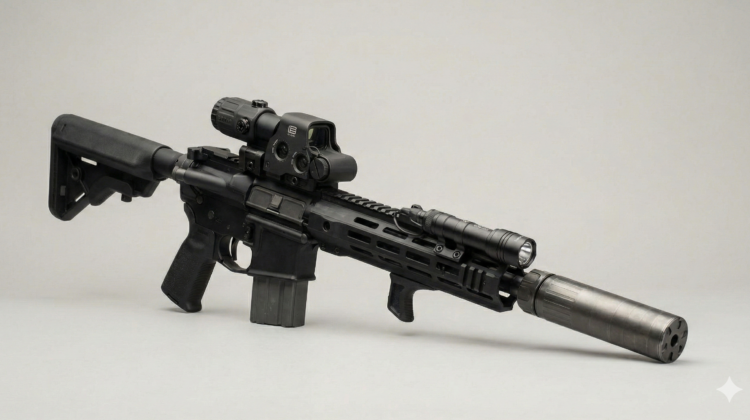
As of January 1, 2026, federal law governing Short Barreled Rifles (SBRs), suppressors, and certain other National Firearms Act (NFA) items has changed. The most significant update is the elimination of the $200 tax stamp fee for several regulated firearms, though registration requirements remain in place.
The $200 excise tax has been removed for suppressors, SBRs, Short Barreled Shotguns (SBSs), and Any Other Weapons (AOWs). While the tax has been eliminated, the NFA registry itself remains fully intact. Buyers and manufacturers must still file the appropriate paperwork and receive approval before taking possession or manufacturing these items.
Applicants are still required to submit ATF Form 1 (to manufacture) or ATF Form 4 (to transfer), undergo a federal background check, submit fingerprints, and provide passport-style photographs. The only procedural difference is that the “tax paid” portion of the application is now a zero-dollar transaction. The $200 tax remains in effect for machine guns and destructive devices.
Pistol braces are currently legal without registration. The ATF’s Final Rule 2021R-08F, which attempted to classify pistols equipped with stabilizing braces as SBRs, was vacated by federal courts in 2025, and the Department of Justice has since dropped all appeals. As a result, stabilizing braces may be owned, attached, and used without registering the firearm as an SBR, provided the barrel remains under 16 inches and the firearm is not otherwise modified into a rifle.
Firearm owners should still exercise caution. Certain modifications, such as adding a vertical foregrip to a pistol with an overall length under 26 inches, may classify the firearm as an AOW. While the AOW tax is now $0, registration is still required.
In late December 2025, many applicants experienced a temporary outage of the ATF eForms system. This “blackout” occurred while the agency updated payment systems to accommodate the new tax structure. Applications submitted and certified before January 1, 2026, were still subject to the $200 tax, and there are currently no provisions for retroactive refunds. Applications submitted on or after January 1, 2026, should process without a tax payment step.
Summary of Current Rules
-
Suppressors: Registration required, $0 tax
-
SBRs: Registration required, $0 tax
-
Pistol braces: Legal, no registration required
-
Machine guns: Registration required, $200 tax
-
Paperwork: ATF Form 1 or Form 4 still required in all applicable cases
Despite the removal of the tax, possession of an unregistered SBR or suppressor remains a federal felony. Do not manufacture, modify, or take possession of any regulated firearm until your ATF Form 1 or Form 4 has been approved and the approved documentation is in your possession.
Interstate Travel With SBRs Remains Restricted Despite Tax Change
Despite the elimination of the $200 tax stamp as of January 1, 2026, federal restrictions on transporting Short Barreled Rifles (SBRs) across state lines remain unchanged. The removal of the tax did not alter the registry or transport provisions of the National Firearms Act (NFA).
Anyone planning to take a registered SBR out of the state where it is registered, even temporarily, must first obtain approval from the Bureau of Alcohol, Tobacco, Firearms and Explosives (ATF). This requirement applies regardless of whether the firearm is being transported for training, competition, hunting, or personal travel.
The required authorization is ATF Form 5320.20, formally titled “Application to Transport Interstate or to Temporarily Export Certain NFA Firearms.” The approved form must be in the registrant’s possession before crossing state lines. Processing times typically range from two to four weeks, making advance planning essential.
Transport rules vary depending on the type of NFA item involved. Interstate travel with SBRs, Short Barreled Shotguns (SBSs), and machine guns requires a fully approved Form 5320.20 in all cases. Suppressors are treated differently under federal law. While a Form 5320.20 is not explicitly required to transport a suppressor across state lines, many owners still obtain one to avoid potential complications with local or state law enforcement.
There is one lawful workaround for owners who must travel immediately and cannot wait for Form 5320.20 approval. If the firearm is temporarily returned to Title I configuration, it is no longer considered an NFA item. This can be accomplished by replacing the short barrel with a barrel 16 inches or longer, or by removing the stock and reverting the firearm to pistol configuration if it originally began life as a pistol and any vertical foregrip is removed. In such cases, the firearm may be transported like any other standard rifle or pistol. Owners must ensure that the short barrel or stock is left behind to avoid “constructive possession” of an unregistered SBR across state lines.
In late 2025, reports circulated regarding a potential modernization of the Form 5320.20 process. The ATF has proposed a rule to digitize interstate travel notifications, potentially allowing near-instant submission or approval for routine travel. However, this proposal has not yet been finalized. The public comment period remains open through January 27, 2026, and until the rule is formally adopted, the existing application process remains in effect.
Firearm owners are advised to proceed with caution. Crossing state lines with an SBR without an approved Form 5320.20 remains a federal felony, regardless of the recent elimination of the tax stamp fee.